The Role of Core in Fitness: Build Strength That Lasts


The core is the central group of muscles that stabilizes your spine and pelvis, enabling every movement your body makes. The role of core in fitness goes far beyond six-pack abs. Your core includes the diaphragm, transversus abdominis, pelvic floor, spinal stabilizers, and abdominal muscles working together as a 3D system. Without a strong, coordinated core, your body compensates by loading passive structures like discs and ligaments, which leads directly to pain and injury. Terpinfit coaches in Pensacola see this pattern constantly: people who train hard but neglect core stability end up sidelined.
What does the core actually include?
Most people picture the core as just the abs. The real anatomy is far more complex and far more interesting.
The core functions as a pressurized cylinder. The diaphragm sits at the top, the pelvic floor at the bottom, the transversus abdominis wraps around the sides, and the spinal stabilizers run along the back. Coordinated activation of these muscles controls intra-abdominal pressure while you breathe normally. That pressure is what stiffens the spine and protects it during every lift, step, and twist.
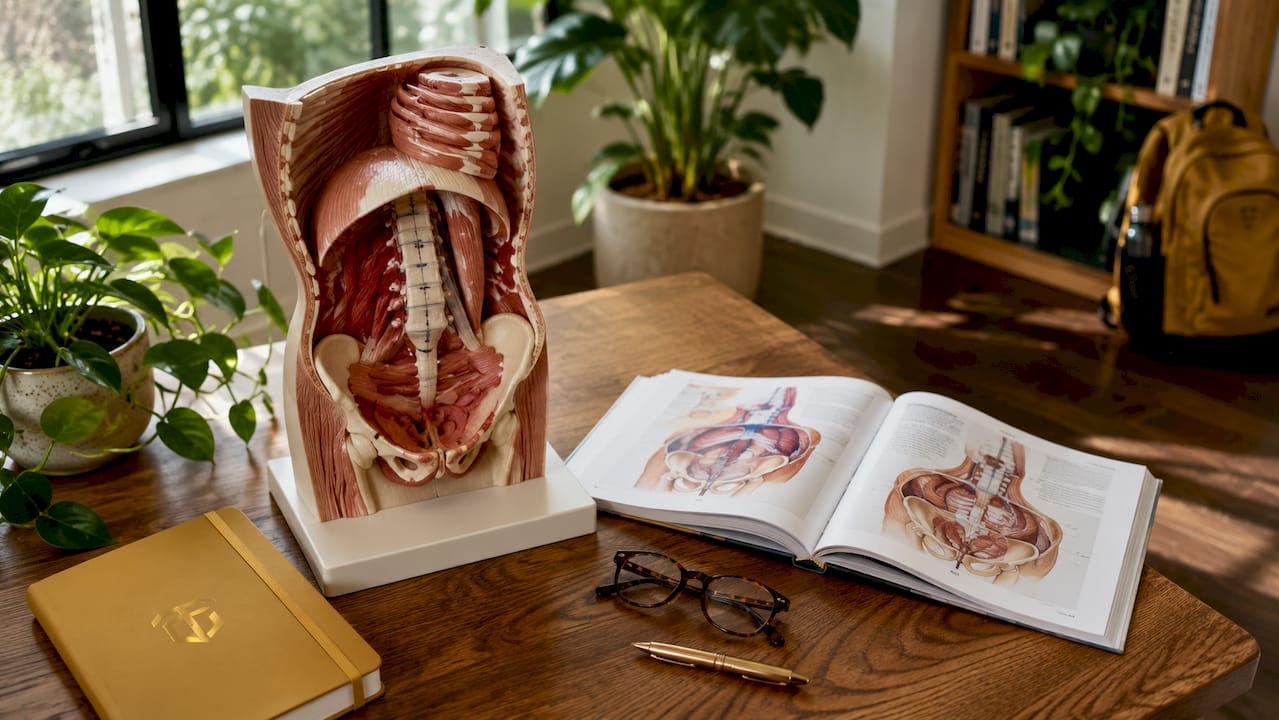
The spine itself is inherently unstable. Core muscles act as dynamic guidewires that protect it and control mechanical pressure during movement. When those guidewires are weak, stress shifts to passive structures, and that is when back pain starts.
Here is what the full core system includes:
Diaphragm: Controls breathing and sets intra-abdominal pressure
Transversus abdominis: The deepest abdominal layer, wraps around the trunk like a corset
Pelvic floor: The base of the cylinder, supports organs and stabilizes the pelvis
Multifidus and erector spinae: Spinal stabilizers that control vertebral movement
Internal and external obliques: Manage rotation and lateral flexion
Rectus abdominis: The front wall, often overemphasized in traditional training
Pro Tip: Breathe out during the hardest part of any core exercise. That exhale naturally engages the transversus abdominis and pelvic floor, which are the deepest stabilizers your spine depends on.
What are the real benefits of core training?
Core strength delivers benefits that reach every corner of your fitness life. The evidence is specific and worth knowing.
A meta-analysis of core training for chronic non-specific low back pain found standardized mean differences of -0.56 for pain reduction and -0.81 for functional improvement, with the strongest results from programs lasting over 8 weeks. That means consistent core work does not just reduce pain. It restores the ability to move well.
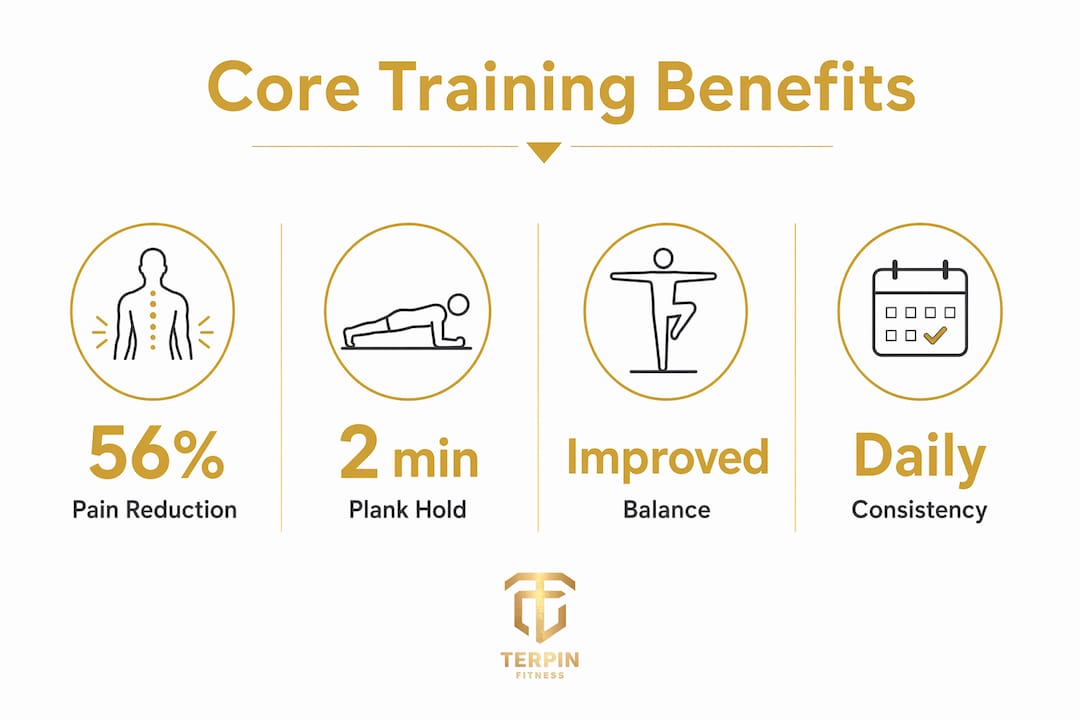
Balance and fall prevention are equally significant. A strong core maintains good posture, enhances mobility, and reduces the risk of falls, especially as you age. For older adults, this is not a minor benefit. It is the difference between independence and injury.
Athletic performance also responds directly to core strength. A 2025 review in Frontiers in Sports and Active Living found that core training improves core strength, dynamic balance, and sprint speed in athletes. Power transfers from the ground up through the core to the arms and legs. A weak link in the middle bleeds energy from every movement.
The full list of benefits from consistent core training includes:
Reduced chronic low back pain and improved daily function
Better balance and lower risk of falls and sports injuries
Faster sprint speed and more efficient power transfer in athletes
Improved posture and reduced strain on the neck and shoulders
More efficient movement patterns in everyday tasks like lifting and carrying
Why are sit-ups outdated, and what works better?
Sit-ups dominated gym culture for decades. The evidence against them is now clear.
Sit-ups push the lumbar spine against the floor and overwork the hip flexors rather than the deep stabilizers. The result is a movement that stresses the lower back while doing little to build the functional stability your body actually needs. Plank variations recruit a more balanced set of core muscles and are safer for the spine.
Modern core training focuses on anti-movement patterns. Anti-extension exercises like planks resist the spine from collapsing forward. Anti-rotation exercises like the Pallof press resist twisting forces. Anti-lateral flexion exercises like side planks resist side bending. These patterns mirror the demands of real life and sport far better than a crunch ever could.
Exercise type | Example | Primary benefit |
Anti-extension | Forearm plank | Spinal alignment and deep stabilizer endurance |
Anti-rotation | Pallof press | Resists twisting forces during dynamic movement |
Anti-lateral flexion | Side plank | Lateral stability and oblique strength |
Dynamic stability | Dead bug | Coordinates limb movement with spinal control |
Functional integration | Farmer’s carry | Full-body core bracing under load |
Effective core training programs focus on muscle control, endurance, and integration rather than isolated strength. That shift in focus is what produces real functional results.
Pro Tip: If you can hold a plank for two minutes without shaking, the exercise has stopped challenging your core. Add instability with a single-leg variation or move to a more demanding anti-rotation drill.
How do you build core training into your routine?
Consistency beats volume every time when it comes to core work.
Physical therapy recommendations emphasize 5 to 10 minutes of core exercise daily over fewer high-volume sessions each week. Short daily sessions keep the neuromuscular patterns active and build the endurance your stabilizers need. A single 45-minute core session on Saturday does not replicate that effect.
Progression is the other non-negotiable. Exercises must remain challenging for continued strength gains. If you finish a set without feeling fatigue, the exercise is no longer producing adaptation. That is the signal to increase difficulty, add load, or switch to a harder variation.
Here is a practical framework for integrating core work:
Start with 5 minutes daily. Pick two exercises from different categories: one anti-extension and one anti-rotation. Perform 3 sets of each with a 10-second rest between sets.
Add one new exercise every two weeks. Introduce a dynamic stability movement like the dead bug once the foundational exercises feel controlled.
Integrate core bracing into all lifts. Squats, deadlifts, and rows all demand core stability. Treat every compound lift as a core exercise by bracing before each rep.
Track your hold times and rep counts. Progress is easy to miss without numbers. Write down your plank time each week and aim to add 5 seconds every session.
Stop at sharp pain. Sharp pain signals the need to stop and seek professional evaluation. Muscle fatigue is normal. Joint or nerve pain is not.
Pro Tip: Add a consistent daily routine by pairing your core work with something you already do every morning, like making coffee. Habit stacking removes the decision and makes consistency automatic.
Key Takeaways
Core strength is the foundation of injury prevention, athletic performance, and functional movement, and building it requires consistent, progressive training rather than high-volume occasional sessions.
Point | Details |
Core anatomy is a 3D system | The diaphragm, pelvic floor, transversus abdominis, and spinal stabilizers all work together to stabilize the spine. |
Core training reduces back pain | Meta-analysis shows significant pain and function improvements, especially with programs lasting over 8 weeks. |
Sit-ups are outdated | Plank variations and anti-movement exercises recruit more balanced muscles and protect the lumbar spine. |
Daily short sessions outperform weekly long ones | 5 to 10 minutes of core work daily produces better results than infrequent high-volume training. |
Progression is required for gains | If an exercise no longer causes fatigue, increase difficulty or switch to a harder variation to keep adapting. |
What I’ve learned from training cores for years
Most people treat core training as an afterthought. They finish their “real” workout and tack on a few planks if they have time. That approach produces weak stabilizers, poor posture, and eventually an injury that sidelines everything else.
What I have seen working with clients at Terpinfit is that the people who prioritize core work from day one move better, recover faster, and stay in the gym longer. A client who could not deadlift without lower back pain for two years was pain-free within six weeks of adding daily anti-extension and anti-rotation work. The lift did not change. The foundation under it did.
The other thing most articles miss is that core strength is directly tied to your quality of life as you age. The ability to carry groceries, get off the floor, and walk without compensating all depend on a stable, strong core. This is not just a fitness goal. It is a longevity strategy.
My advice: treat your core like you treat your sleep. Non-negotiable, every day, regardless of what else is on the program. The impact on athletic performance alone makes it worth the five minutes.
— Marc
Core training with Terpinfit in Pensacola
Building a strong core is straightforward when you have a clear plan and someone to keep you on track.

Terpinfit offers both in-person and online personal training in Pensacola built around your specific goals, movement patterns, and fitness level. Every program includes a structured core component designed to build stability from the ground up, not just surface-level ab work. Whether you are recovering from back pain, training for a sport, or simply want to move better every day, Terpinfit builds a progression plan that keeps you challenged and injury-free. Ready to get started? View services and reach out to connect with a Terpinfit coach today.
FAQ
What muscles make up the core?
The core includes the diaphragm, transversus abdominis, pelvic floor, multifidus, erector spinae, and internal and external obliques. These muscles work together as a coordinated system to stabilize the spine and pelvis during movement.
How does core strength reduce back pain?
Core muscle training significantly reduces pain and improves physical function in people with chronic low back pain, with the strongest results from programs lasting over 8 weeks. Stronger stabilizers reduce stress on passive spinal structures like discs and ligaments.
Are sit-ups good for core training?
Sit-ups overwork the hip flexors and push the lumbar spine against the floor, which can cause lower back strain. Plank variations and anti-movement exercises are safer and recruit a more balanced set of core muscles.
How often should you train your core?
Physical therapy guidance recommends 5 to 10 minutes of core exercise daily rather than longer, infrequent sessions. Daily short sessions build the neuromuscular endurance your stabilizers need to function during all other activities.
When should you stop a core exercise?
Stop immediately if you feel sharp pain during any core exercise. Muscle fatigue is a normal training signal, but joint or nerve pain requires professional evaluation before continuing.
Recommended
Comments