Strength Training Basics Explained for Beginners

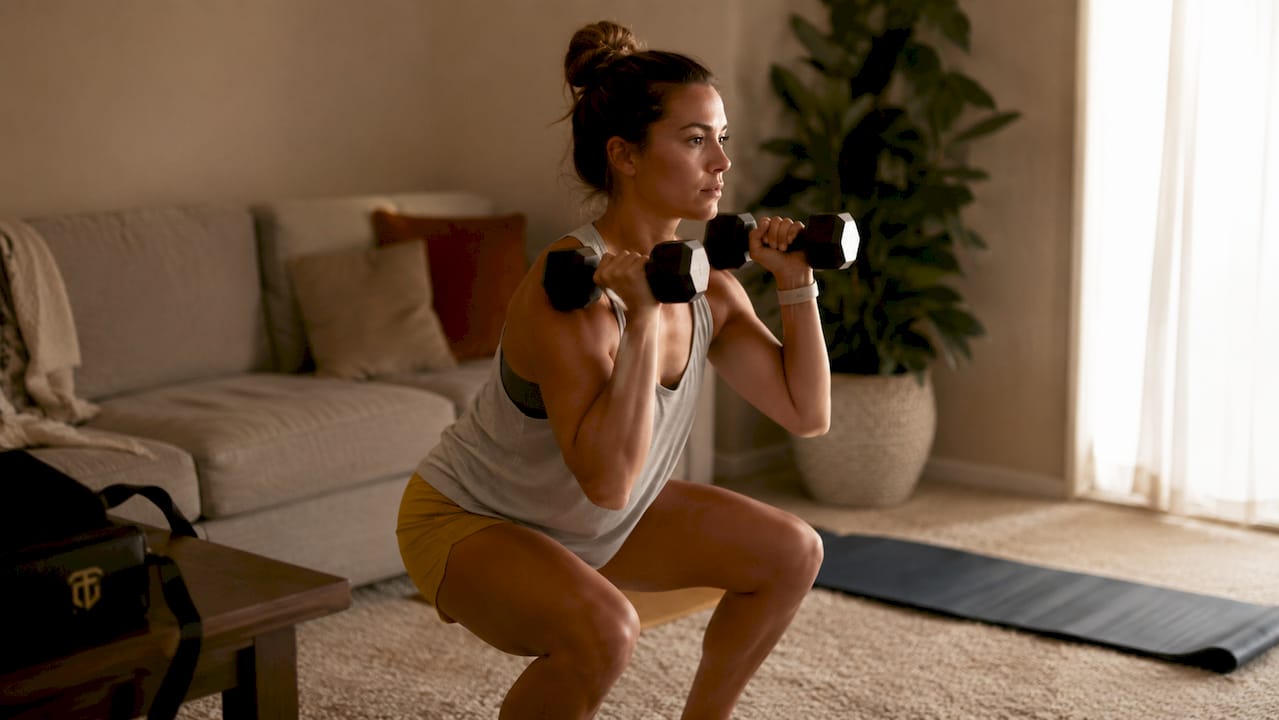
Strength training is any exercise that forces your muscles to work against external resistance to build strength, size, endurance, and physical function. The American College of Sports Medicine synthesized 137 systematic reviews covering more than 30,000 participants and confirmed that resistance training improves all of these outcomes versus no training. That scale of evidence settles the debate. You do not need a gym membership, a barbell, or a personal trainer on day one. Bodyweight exercises, resistance bands, and light dumbbells all qualify as legitimate strength training tools for beginners.
What are the fundamental principles of strength training basics explained?
Progressive overload is the single most important concept in strength training. It means you gradually increase the challenge placed on your muscles over time. Without it, your body adapts to a fixed workload and stops changing.
Most beginners picture progressive overload as adding weight every session. That is not accurate. Progressive overload includes adding more reps at the same load before you ever touch a heavier weight. This approach protects beginners from jumping too far too fast.
The 2026 ACSM position stand identifies the key training variables that drive results:
Load: Heavier loads at or above 80% of your one-rep max build strength most efficiently in healthy adults.
Volume: 2–3 sets per exercise, performed 2 or more days per week, produce measurable strength gains.
Range of motion: Full range of motion on every rep is non-negotiable. Partial reps reduce effectiveness and increase injury risk.
Frequency: Training each major muscle group at least twice per week is the minimum effective dose.
Pro Tip: You do not need to train to complete muscle failure to get stronger. Stopping 1–2 reps before failure protects your form and keeps you consistent across sessions.
Early gains in beginners come mostly from neurological adaptation, not muscle growth. Your nervous system learns to recruit muscle fibers more efficiently before your muscles actually get bigger. This is why beginners often feel stronger within two weeks even before visible changes appear.
How can beginners safely start strength training at home or in a gym?
The best starting point is a short list of exercises that cover your major muscle groups. You do not need dozens of movements. You need a few done well.
Beginner-friendly exercises include:
Squats (bodyweight or goblet squat with a light dumbbell)
Push-ups (standard or modified on knees)
Dumbbell rows or resistance band rows
Glute bridges (bodyweight)
Overhead press (light dumbbells or resistance bands)
Plank holds (core stability)
Harvard Health’s 2026 guidance confirms that bodyweight and resistance bands are equally effective as gym equipment for beginners. That removes the barrier of cost and access entirely. A set of loop resistance bands covers most lower body and pulling movements without any gym required.
Start with 2 sets of 8–12 reps per exercise. Rest 30–90 seconds between sets. Rest periods of 30–90 seconds support recovery between sets, with longer rest needed for heavier or more demanding efforts. Choose a weight or resistance level where the last 2–3 reps feel challenging but your form stays clean.

Pro Tip: Pick a load you can control through the full range of motion. If your form breaks down before you finish the set, the weight is too heavy.
Technique mastery comes before load increases. Beginners who rush to heavier weights before their movement patterns are solid get hurt or plateau early. Spend your first 3–4 weeks learning the movement, not chasing numbers.
What is the role of exercise selection and training structure for beginners?
Compound exercises are the foundation of any beginner program. A compound movement crosses two or more joints and recruits multiple muscle groups at once. Squats, push-ups, and rows are all compound movements. They give you more return per minute of training than isolation exercises like bicep curls.
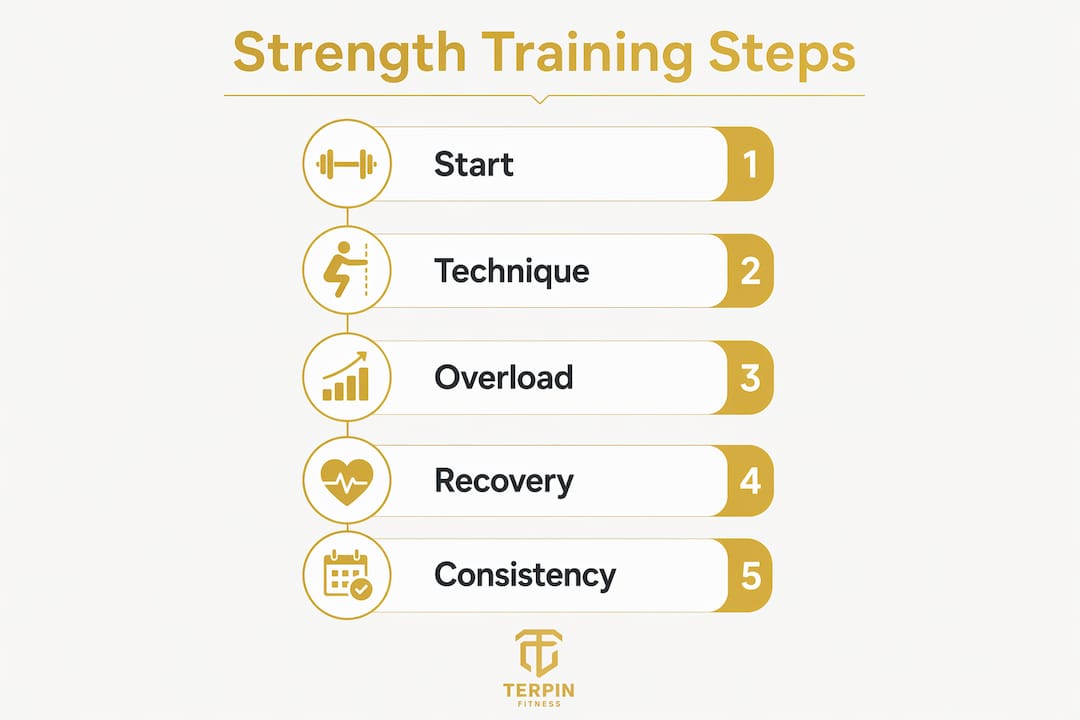
Multi-joint compound exercises are the most efficient choice for beginners training major muscle groups. Efficiency matters when you are new because your schedule and recovery capacity are both limited. A 30-minute session built around 4–5 compound movements covers your entire body.
Exercise type | Examples | Primary benefit |
Compound (multi-joint) | Squat, push-up, deadlift, row | Trains multiple muscles simultaneously |
Isolation (single-joint) | Bicep curl, leg extension, lateral raise | Targets one specific muscle |
Bodyweight compound | Push-up, lunge, glute bridge | No equipment needed, full-body stimulus |
Band-based compound | Band row, band squat, band press | Portable, joint-friendly resistance |
Isolation exercises are not useless. They become useful after you have built a base with compound movements. A beginner spending 80% of their training time on compound lifts and 20% on isolation work has the right balance.
Structure your sessions by starting with the hardest compound movements first, when your energy is highest. Move to lighter isolation work at the end. This order protects performance on the exercises that matter most.
What common beginner mistakes should be avoided?
The most damaging beginner mistake is going too heavy too soon. Heavy loads before proper technique is established create compensation patterns that stick. Those patterns become harder to fix the longer they persist.
Common mistakes that slow progress include:
Training to failure every set: This spikes fatigue and degrades form. Stop 1–2 reps short of failure on most sets.
Skipping rest days: Muscles grow during recovery, not during the workout itself. Two to three sessions per week with rest days between is the proven starting point.
Ignoring range of motion: Full range of motion drives strength improvements. Cutting reps short to use more weight is counterproductive.
Changing programs too often: Beginners need 6–8 weeks on the same program to see real adaptation. Switching every two weeks resets the learning curve.
No scheduled training days: Consistency requires a fixed schedule, not good intentions. Block your training days like appointments.
Pro Tip: When a weight feels easy, add 1–2 reps before you increase the load. This approach, confirmed by Harvard Health, keeps progression steady without risking form breakdown.
Building a consistent training routine is the single biggest predictor of long-term results. The best program is the one you actually follow. Realistic goals, a fixed schedule, and gradual progression beat any advanced protocol done inconsistently.
The ACSM’s 2026 position makes clear that resistance training prescriptions work best when they are individualized and flexible. Rigid programs that do not account for your recovery, schedule, or starting fitness level produce worse outcomes than adaptable ones.
Key Takeaways
Strength training works because progressive overload, proper technique, and consistent frequency combine to drive measurable gains in strength and physical function for beginners.
Point | Details |
Progressive overload drives results | Add reps before adding weight to progress safely and steadily. |
Frequency beats intensity for beginners | Train each muscle group at least twice per week with manageable effort. |
Compound exercises first | Build your program around squats, push-ups, and rows before adding isolation work. |
Form before load | Master full range of motion on every exercise before increasing resistance. |
Consistency is the variable that matters most | A fixed schedule with realistic goals outperforms any advanced program done sporadically. |
What I’ve learned coaching beginners from scratch
The fear I see most often is not about getting hurt. It is about looking foolish. New lifters worry they are doing it wrong, that everyone is watching, that they need to know more before they start. That fear keeps people out of the gym for months or years longer than necessary.
The truth is that the most meaningful gains come from simply starting any resistance training, not from finding the perfect program. I have worked with beginners in Pensacola who built real, visible strength using nothing but bodyweight and a set of resistance bands in their living room. The equipment was not the variable. The consistency was.
What surprises most beginners is how fast the nervous system responds. Within two weeks of starting, people feel stronger even before their body changes. That early feedback is powerful. It builds the habit before the results arrive.
My honest advice: pick five exercises, train three days a week, and do not change anything for six weeks. You will be stronger. You will move better. And you will have enough experience to make smarter decisions about what to do next. Complexity is a reward for consistency, not a starting point.
— Marc
Terpinfit personal training for beginner strength training
Terpinfit offers both in-person training in Pensacola and online coaching for beginners who want structured guidance from the start.
Starting with a trainer removes the guesswork from exercise selection, load progression, and form correction. Beginners who train with professional support build correct movement patterns faster and avoid the setbacks that come from self-taught errors. Whether you are in Pensacola or anywhere in the U.S., Terpinfit’s personal training programs are built around your starting point, your schedule, and your goals. You get a program that fits your life, not a generic template.
FAQ
What is strength training?
Strength training is any exercise that makes your muscles work against external resistance to build strength, size, endurance, or physical function. This includes free weights, resistance bands, bodyweight exercises, and Pilates.
How often should beginners do strength training?
Beginners should train each major muscle group at least 2 days per week. The 2026 ACSM position stand confirms this frequency produces measurable strength gains in healthy adults.
Can you build strength without gym equipment?
Yes. Harvard Health’s 2026 research confirms that bodyweight exercises and resistance bands are equally effective as gym equipment for beginners starting a strength training program.
How do you know when to increase the weight?
Add reps at your current load first. When you can complete the top of your rep range with clean form, then increase the weight by the smallest available increment.
How long before beginners see results from strength training?
Most beginners notice strength improvements within 2 weeks due to neurological adaptation. Visible muscle changes typically follow after 6–8 weeks of consistent training.
Recommended
Comments