How to Stay Motivated on Your Fitness Journey


Staying motivated on your fitness journey is not about willpower. It is about designing systems that make showing up the path of least resistance. Behavioral science defines exercise motivation as an emergent property of your environment and habits, not a fixed personality trait. The most effective fitness motivation tips share one thing: they reduce friction at the start, not the finish. Small, deliberate actions like a 5-minute movement commitment, a specific workout intention, and a visual streak tracker compound into lasting consistency. This article breaks down each method with the research behind it.
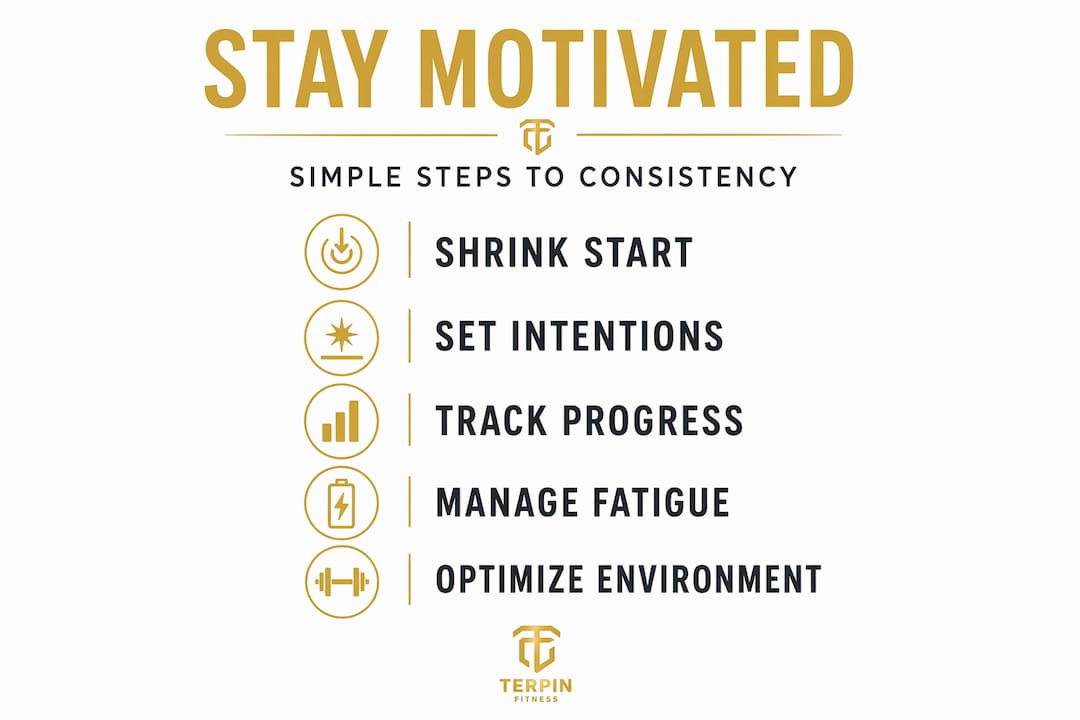
How to stay motivated on your fitness journey by shrinking the start
The single biggest barrier to exercise is not laziness. It is the mental weight of starting. Committing to just 5 minutes of movement lowers that barrier dramatically, with 87% of people who begin a 5-minute session continuing well past it. That number tells you something important: the resistance lives at the door, not inside the workout.
The two-minute rule works on the same principle. Completing the smallest version of a task immediately breaks procrastination before it takes hold. For fitness, that means lacing up your shoes and stepping outside counts as a win. Once you are moving, momentum takes over.
Habit stacking makes this even more reliable. You attach a new behavior to an existing one so the trigger is automatic. Here is how to apply it:
Morning coffee habit. While the coffee brews, do 10 bodyweight squats. The coffee is the trigger; the squats are the new behavior.
Post-lunch walk. After you eat, walk for 5 minutes before returning to your desk. The meal ends and the walk begins without a decision.
Evening wind-down. Before you brush your teeth, do a 5-minute stretch. The toothbrush becomes the cue.
Commute anchor. If you drive to a gym, pack your bag the night before and place it by the door. The bag in your path is the prompt.
Pro Tip: Set a 5-minute timer and tell yourself you only have to work out until it goes off. You will almost never stop when it does.
Why specific workout intentions triple your follow-through
Vague goals fail because they leave too many decisions open. “I’ll work out this week” requires you to decide when, where, and what every single day. That decision fatigue drains motivation before you ever move. Specific implementation intentions triple the likelihood of following through on fitness commitments compared to general goals. The format is simple: “I will do X at Y time in Z location.”
A strong workout intention looks like this:
Specific activity: “I will do a 30-minute strength session” beats “I will exercise.”
Fixed time: “At 6:30 a.m.” removes the daily negotiation with yourself.
Named location: “At the gym on Palafox Street” or “in my living room” closes the loop.
Contingency plan: “If I miss the morning, I will do 20 minutes at lunch” prevents one miss from becoming a week off.
Writing these intentions down the night before is more effective than setting them in the morning. Your brain treats a written plan as a commitment, not a suggestion. Terpinfit coaches use this exact approach when building individualized workout plans with clients, because specificity is where vague fitness goals become real behavior change.
The contingency plan piece is underused. Most people treat a missed workout as a failure. A pre-written backup plan reframes it as a rescheduled appointment. That single shift in thinking prevents the guilt spiral that kills long-term consistency.

Does visual progress tracking actually keep you consistent?
Visual tracking works because of loss aversion, a well-documented behavioral principle. Once you have a 3-day exercise streak on a calendar, the prospect of breaking it feels worse than the effort of maintaining it. A 3-day streak increases the probability of exercising the next day by 65%. That is a significant lift from a simple X on a paper calendar.
The neurochemical side reinforces this. Each completed workout triggers a small dopamine release. Seeing a visual chain of completed days links that reward to the streak itself, not just the exercise. You start protecting the streak as its own goal.
Tracking method | Best for | Setup time |
Paper wall calendar | Visual impact, low tech | Under 2 minutes |
Habit tracking app | Reminders and data history | 5–10 minutes |
Fitness journal | Logging sets, reps, and notes | 5 minutes per session |
Whiteboard in gym space | Daily visibility at home | Under 5 minutes |
Pro Tip: Use a red marker on a paper calendar. The color contrast makes your streak more visually striking and harder to ignore when you feel like skipping.
A visual progress tracker also gives you objective data when motivation dips. On a low-energy day, seeing 18 consecutive Xs on a calendar is more persuasive than any internal pep talk.
How to manage fatigue and setbacks without losing momentum
Biological fatigue and motivational dips feel identical but require opposite responses. Pushing through true physical fatigue causes injury and burnout. Pushing through a motivational dip builds the habit. Learning to tell them apart is one of the most underrated fitness skills.
Biological fatigue often masquerades as lack of motivation. Before you skip a workout, check the basics: Did you sleep fewer than 7 hours? Are you dehydrated? Have you eaten enough today? If the answer to any of those is yes, address the recovery need first. A 20-minute nap and a glass of water will do more for your workout than a motivational video.
The Red Light/Yellow Light/Green Light framework gives you a daily check-in system:
Green Light: You feel rested and ready. Train at full intensity.
Yellow Light: You feel tired but functional. Cut intensity by 30–40% and focus on movement quality over load.
Red Light: You feel genuinely unwell or injured. Rest, stretch, or walk. Do not push.
Adjusting workout intensity based on daily capacity prevents the all-or-nothing thinking that causes people to quit entirely after one hard week. A Yellow Light day still counts. It still builds the habit.
“Viewing flexibility as resilience, not failure, is what separates people who train for years from those who quit after months.” — Psychology Today
Reframing setbacks as pivots rather than failures removes the guilt that compounds missed workouts into missed weeks. One skipped session is data, not a verdict on your character.
What does a frictionless workout environment actually look like?
Motivation is an emergent property of your environment, not a character trait you either have or lack. The most consistent exercisers do not rely on feeling motivated. They build environments where working out is the easiest available option.
Pre-planning your workout essentials the night before removes the morning decision entirely. Gym clothes on the chair, bag by the door, and a written workout plan mean zero friction between waking up and starting. Each removed decision is one less chance for resistance to win.
Scheduling workouts as fixed appointments works the same way. A workout at 6:30 a.m. on Tuesday is not a preference. It is a meeting. You do not cancel meetings with yourself any more than you cancel them with your boss.
The 3-3-3 Rule offers a practical structure for weekly training balance:
Day type | Focus | Example |
3 strength sessions | Build muscle and metabolic base | Squats, deadlifts, pressing |
3 cardio or mobility sessions | Recovery and aerobic capacity | Walking, cycling, yoga |
1 full rest day | Tissue repair and nervous system recovery | Sleep, stretching, nutrition |
This structure prevents the overtraining that kills motivation and the undertraining that stalls progress. Building an accountability fitness routine around this framework gives you a repeatable weekly template that does not require daily decisions.
Key Takeaways
Staying motivated on a fitness journey requires systems, not willpower. The most effective approach combines a low-friction start, specific intentions, visual tracking, and adaptive recovery to build habits that outlast any motivational peak.
Point | Details |
Shrink the start | Commit to 5 minutes only. 87% of people continue past it once they begin. |
Write specific intentions | State the activity, time, and location the night before to triple follow-through rates. |
Track streaks visually | A 3-day streak raises next-day exercise odds by 65% through loss aversion. |
Use the traffic light check | Rate your daily readiness as Green, Yellow, or Red before choosing workout intensity. |
Remove environmental friction | Lay out gear the night before and schedule workouts as fixed appointments. |
Motivation is a system, not a spark
Here is what I have seen working with people on their fitness goals: almost everyone starts with the wrong model. They think motivation is something you feel before you work out. You wait for it, and when it does not show up, you skip. That model guarantees failure.
The real sequence runs the other way. You act first, and motivation follows. Every client I have worked with who built a lasting routine did it by making the start so small it felt almost embarrassing. A 5-minute walk. Ten push-ups. One set. The size does not matter at the beginning. The repetition does.
What I have also learned is that rigid plans are the enemy of long-term adherence. Life in Pensacola, or anywhere else, does not follow a fixed schedule. Kids get sick. Work runs late. Sleep gets cut short. The people who stay consistent are not the ones with the most discipline. They are the ones with the most flexibility built into their system. A Yellow Light day is not a failure. It is the plan working exactly as designed.
The compounding effect of small, consistent actions is real, and it is slow enough that most people quit before they see it. Trust the system. Protect the streak. Adjust the intensity when you need to. The progress will show up.
— Marc
Terpinfit personal training in Pensacola
Knowing the strategies is one thing. Having a coach who builds them around your specific schedule, goals, and daily capacity is another. Terpinfit offers both in-person and online personal training in Pensacola, designed to take the guesswork out of consistency.

A Terpinfit trainer helps you set specific workout intentions, build a weekly structure that fits your life, and adjust your plan when fatigue or setbacks hit. You get accountability, expert programming, and a system that works on your low-motivation days as much as your best ones. Whether you prefer training in person or online, personalized training in Pensacola gives you the structure that makes motivation a byproduct, not a prerequisite. Reach out through the services and inquiry page to get started.
FAQ
What is the fastest way to build workout motivation?
Commit to just 5 minutes of movement. Research shows 87% of people who start a 5-minute session continue past it, meaning the act of starting generates motivation rather than the other way around.
How do specific workout intentions help you stay consistent?
Writing down the exact activity, time, and location of your workout triples follow-through rates compared to vague goals. A contingency plan for missed sessions prevents one skip from becoming a longer break.
What should you do when you feel too tired to work out?
Check sleep, hydration, and nutrition first. Biological fatigue often mimics low motivation, and addressing recovery needs before pushing through prevents injury and burnout.
Does tracking streaks actually improve consistency?
A 3-day exercise streak raises the probability of working out the next day by 65%. Visual tracking leverages loss aversion, making the prospect of breaking a streak feel worse than the effort of maintaining it.
How do you recover motivation after missing workouts?
Reframe the missed session as a pivot, not a failure. Viewing flexibility as resilience prevents the guilt spiral that turns one missed workout into a week-long break.
Recommended
Comments