Fitness Goal Setting: What It Is and How It Works


Fitness goal setting is the practice of establishing clear, measurable objectives to guide your physical activity and health improvements. It is the foundation of every effective weight loss plan and exercise program. A meta-analysis on goal setting found a medium effect size (d=0.55) for goal setting on physical activity adherence and health outcomes. That number means goal setting produces real, consistent results across a wide range of people. The SMART framework, recognized by exercise science organizations worldwide, turns vague intentions into plans a trainer can actually use.
What is fitness goal setting and why does it matter?
Fitness goal setting is the process of defining specific, actionable targets for your physical activity, body composition, or health behaviors. Without a defined target, most people default to vague intentions like “get in shape” or “lose weight,” which provide no direction and no way to measure progress. SMART goals must specify an outcome, a metric, a timeline, and a reason. That level of detail is what separates a wish from a plan.
The importance of fitness goals goes beyond motivation. A well-written goal gives a trainer enough information to build a full training program from scratch. If your goal is “I want to lose 15 pounds in 12 weeks by attending three strength training sessions per week,” a coach can design every workout, track every metric, and adjust the plan as needed. Vague goals make that kind of programming impossible.

Goal setting also works at a psychological level. When you write down a specific target, you activate a commitment to that outcome. That commitment drives the daily decisions that add up to real change over time.
What is the SMART framework for fitness goals?
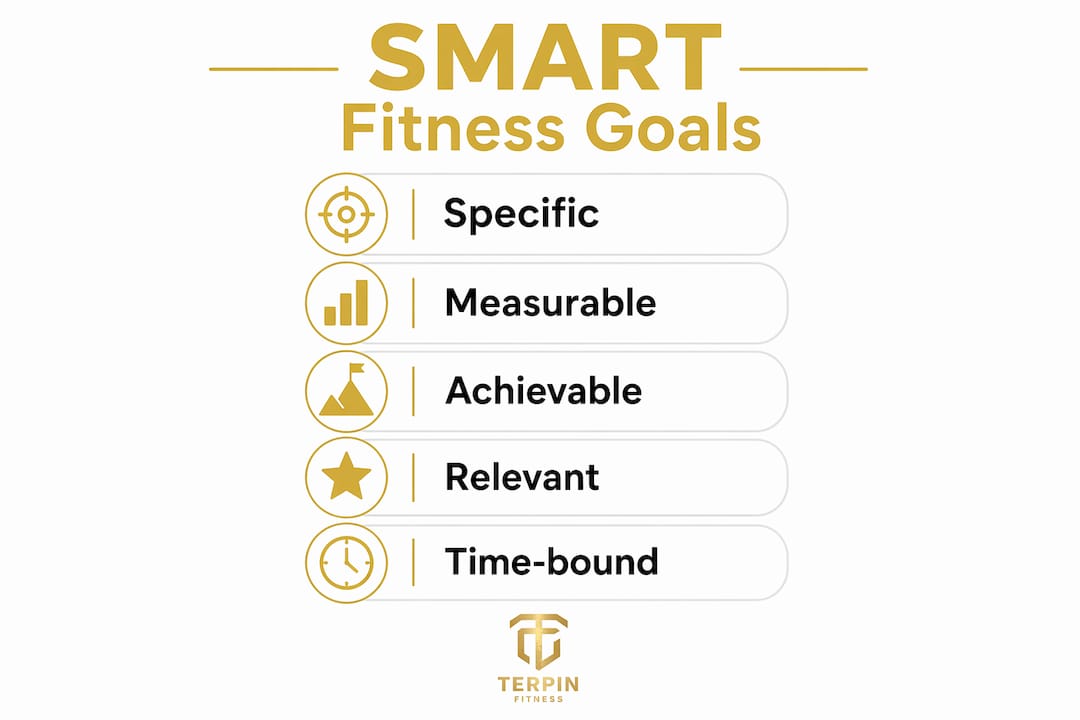
SMART is the industry standard for converting vague fitness intentions into structured plans. Each letter represents one non-negotiable component of a well-formed goal.
Specific: Name the exact activity, body part, or outcome. “Run three miles” beats “exercise more.”
Measurable: Attach a number. “Lose 10 pounds” or “complete 10 push-ups without stopping.”
Achievable: Set a target that challenges you without being physically impossible. Losing 1–2 pounds per week is achievable. Losing 20 pounds in two weeks is not.
Relevant: Connect the goal to something that matters to you personally. A goal tied to a real reason, like fitting into a wedding dress or reducing blood pressure, holds up under pressure.
Time-bound: Set a deadline. “By june 1” forces you to act now rather than indefinitely.
SMART goals are programming tools, not just motivational slogans. A trainer reading your SMART goal should be able to draft a full training plan without asking a single follow-up question. That is the real test of whether your goal is specific enough.
Experts recommend focusing on 1 to 3 goals at a time. Chasing five goals simultaneously splits your attention and increases the chance of burnout. Pick your top priority, build consistency around it, then add a second goal once the first becomes a habit.
Pro Tip: Write your SMART goal on paper and hand it to a friend or trainer. If they can describe your training plan back to you without asking questions, your goal is specific enough.
How to categorize fitness goals: process, performance, and outcome
Not all fitness goals work the same way. Three goal types serve different roles in keeping you motivated and on track.
Process goals focus on daily or weekly habits. Examples include walking 8,000 steps per day, drinking 80 ounces of water daily, or completing four workouts per week. These goals are entirely within your control, which makes them the most reliable source of daily motivation.
Performance goals target capability milestones. Examples include running a 5K without stopping, deadlifting your body weight, or holding a plank for 60 seconds. These goals measure what your body can do, not just how it looks.
Outcome goals describe long-term results. Losing 30 pounds, dropping two dress sizes, or reaching a healthy BMI are outcome goals. They provide direction but depend on many variables outside your direct control.
Process goals deserve more credit than they typically get. When you hit your daily step count or complete your scheduled workouts, you feel successful regardless of what the scale says that morning. That daily sense of progress keeps most people consistent far longer than chasing a number on a scale alone.
Balancing all three goal types produces the best long-term results. Outcome goals give you direction. Performance goals show you growing stronger. Process goals keep you showing up every day.
What timeframes should fitness goals follow?
Fitness experts define short-term goals as spanning 2–12 weeks and long-term goals as spanning 3–12 months. Each timeframe serves a different purpose in your overall plan.
Goal type | Timeframe | Primary purpose | Example |
Short-term | 2–12 weeks | Build momentum and habits | Complete 3 workouts per week for 6 weeks |
Long-term | 3–12 months | Drive significant change | Lose 25 pounds by december 31 |
Short-term goals build momentum by giving you frequent wins. Hitting a six-week goal proves to yourself that you can follow through. That proof matters more than most people realize, especially in the first few months of a new program.
Long-term goals anchor your effort to a meaningful outcome. They answer the question “why am I doing this?” on the days when motivation is low. A long-term goal like running a 10K in october or reaching a healthy weight before a medical checkup gives your short-term habits a destination.
The most effective approach sequences both. Set a long-term outcome goal first, then work backward to create two or three short-term process and performance goals that move you toward it. Review and adjust your short-term goals every 4–6 weeks based on your actual progress.
What are common misconceptions about fitness goal setting?
The biggest misconception about SMART goals is that they are primarily a motivational tool. They are not. SMART is a programming framework, and over-relying on the acronym without understanding the underlying principles limits its effectiveness. Exercise and Sports Science Australia’s expert statement warns against oversimplifying goal setting into a checklist exercise.
A second misconception is that SMART goals work equally well for everyone. They do not. Beginners and insufficiently active individuals often respond better to open-ended goals than to rigid, highly specific targets. A daily step challenge with no fixed number, for example, can improve engagement and psychological outcomes more effectively than a strict SMART goal for someone just starting out. Flexibility at the beginning builds the habit of moving. Specificity becomes more valuable once that habit is established.
The third and most overlooked misconception is that setting a goal is enough. It is not. Goal striving, which includes action planning and self-monitoring, is what converts a written goal into a realized achievement. Writing “I will go to the gym on monday, wednesday, and friday at 7 a.m.” is goal striving. Tracking your workouts in a notebook or app is self-monitoring. Without these behaviors, even a perfectly written SMART goal stays on paper.
“Setting a goal without a plan for how you will execute it is like writing a destination on a map without drawing the route.”
Pro Tip: Use “if-then” planning to handle obstacles before they happen. “If I miss my monday workout, then I will go on tuesday morning instead.” This single habit dramatically improves follow-through.
How to set fitness goals that stick
Turning goal-setting theory into daily practice requires a few specific habits. Follow these steps to build a goal structure that holds up over time.
Limit yourself to 1–3 goals. More than three active goals at once dilutes your focus. Pick the goal that matters most right now and commit to it fully before adding others.
Write your goals down in specific language. “I will lose 10 pounds by august 15 by completing four workouts per week and limiting processed food to one meal per week” is a written goal. “Lose weight” is not.
Identify your process goals first. Before you chase an outcome, define the daily and weekly habits that will get you there. Process goals are what you actually control.
Track your progress weekly. Weigh yourself on the same day each week, log your workouts, and note how you feel. Data removes guesswork and shows you what is working.
Build in an accountability system. Sharing your goals with a trainer, a workout partner, or even a family member increases follow-through. Learning how to communicate goals with your trainer is one of the highest-leverage steps you can take.
Adjust without quitting. If a goal proves too aggressive or too easy after four weeks, revise the target. Adjusting a goal is not failure. Abandoning it because it no longer fits is.
Use an accountability structure. Building an accountability fitness routine around your goals turns intention into consistent action.
The difference between people who reach their fitness goals and those who do not usually comes down to steps four and five. Tracking and accountability are not optional extras. They are the mechanism that makes goal setting work.
Key takeaways
Fitness goal setting works because it converts vague intentions into specific, trackable plans that give both you and your trainer a clear direction to follow.
Point | Details |
Define goals with SMART criteria | Goals must include an outcome, a metric, a timeline, and a personal reason to be useful. |
Limit active goals to 1–3 | Focusing on fewer goals builds consistency and prevents burnout. |
Balance all three goal types | Combine process, performance, and outcome goals to stay motivated at every stage. |
Use short and long-term timeframes | Short-term goals (2–12 weeks) build momentum; long-term goals (3–12 months) drive significant change. |
Pair goal setting with goal striving | Action planning and self-monitoring are what turn written goals into real results. |
Why most people get fitness goals wrong
I have worked with a lot of people who came in with goals. Most of them had the same problem. The goal sounded right on the surface but had no real structure underneath it. “I want to get fit” or “I want to lose weight before summer” are not goals. They are wishes dressed up as goals.
The SMART framework fixes the structure problem, but it does not fix the execution problem. I have seen people write perfect SMART goals and still fail because they never built the daily habits to support them. Goal striving is the missing piece most fitness content ignores. The “if-then” planning habit alone, where you decide in advance how you will handle missed workouts or bad weeks, changes the outcome more than any goal-writing exercise.
The other thing I push hard on is balancing goal types. Outcome goals feel exciting at the start, but they are the least reliable source of daily motivation. Process goals are what keep you in the gym on a tuesday when you are tired and the scale has not moved in two weeks. Build your plan around what you can control every single day. The outcome will follow.
View your fitness goals as living commitments, not fixed contracts. Adjust them when your life changes, when you get stronger, or when a goal no longer fits your situation. The goal is to keep moving forward, not to protect a number you wrote down in january.
— Marc
Terpinfit personal training in Pensacola
Setting a goal is the first step. Having an expert help you build the plan behind it is what makes the difference between a goal that stays on paper and one that becomes your new reality.

Terpinfit offers both online and in-person personal training in Pensacola designed around your specific goals, your schedule, and your starting point. Whether you are working toward weight loss, building strength, or improving your overall health, Terpinfit’s trainers use SMART frameworks and structured programming to build a plan that fits your life. If you are ready to stop guessing and start following a clear, personalized plan, view Terpinfit’s services and take the first step today.
FAQ
What is fitness goal setting?
Fitness goal setting is the process of defining specific, measurable objectives for your physical activity and health. It converts vague intentions like “get fit” into structured plans with clear targets, timelines, and daily habits.
What are SMART fitness goals?
SMART fitness goals are Specific, Measurable, Achievable, Relevant, and Time-bound. This framework gives both you and your trainer enough detail to build a full training program around your goal.
What are the three types of fitness goals?
The three types are process goals (daily habits), performance goals (capability milestones), and outcome goals (long-term results like weight loss). Balancing all three produces the best long-term motivation and adherence.
How long should a fitness goal timeframe be?
Short-term fitness goals typically span 2–12 weeks and focus on building habits and momentum. Long-term goals span 3–12 months and target significant changes in fitness or body composition.
Do SMART goals work for beginners?
Rigid SMART goals are less effective for beginners or people with low activity levels. Open-ended goals, like a daily step challenge, often improve engagement and psychological outcomes better at the start of a fitness program.
Recommended
Comments